Breaking Enigma with Index of Coincidence on a Commodore 64
Everything we’ve done so far requires a crib. The brute-force cracker tested candidate settings against known plaintext. Turing’s Bombe used contradictions between known plaintext and ciphertext to eliminate wrong settings. No crib, no attack.
But what if you intercepted a message and had no idea what it said? No weather report header, no formulaic greeting, no re-sent traffic. Just ciphertext.
William Friedman developed a tool for exactly this problem in 1922. It doesn’t need known plaintext. It doesn’t even need to know the language. It measures whether a piece of text looks like language at all or whether it looks like random noise. He called it the index of coincidence.
What the Index of Coincidence Measures
Pick two random letters from a piece of English text. What’s the probability they’re the same letter? Not very high, but higher than you’d think, because letter frequencies aren’t uniform. E appears about 13% of the time. Z appears less than 0.1%. Two randomly chosen letters are more likely to both be E than to both be Z.
For English text, the probability of a match is about 0.0667. For German it’s about the same (0.0762 by some measurements, but the exact number depends on the text). For truly random text where all 26 letters are equally likely, it’s 1/26 = 0.0385.
That difference is the entire attack. Decrypt a ciphertext with the wrong Enigma settings and the output looks random: IC near 0.038. Decrypt with the right settings and the output is German: IC near 0.067. No crib needed. The statistical properties of the language itself are the signal.
The Formula
The IC of a text with N letters is:
$$IC = \frac{\sum_{i=0}^{25} n_i \cdot (n_i - 1)}{N \cdot (N - 1)}$$where $n_i$ is how many times letter $i$ appears. The numerator counts how many ways you could pick two copies of the same letter. The denominator counts how many ways you could pick any two letters. The ratio is the probability that two randomly chosen letters match.
For a C64 implementation, we don’t need the division. We just compute the numerator (call it the IC sum) and compare it to a threshold. If IC should be above 0.050, that means the sum should be above $0.050 \times N \times (N-1)$. For a 60-character message, that’s $0.050 \times 60 \times 59 = 177$. A 16-bit integer comparison. No floating point needed. The C64’s BASIC ROM has a full floating-point engine, but we don’t have to touch it.
Why the Plugboard Doesn’t Matter
This is the best part. The plugboard is a monoalphabetic substitution: it swaps pairs of letters before and after the rotors. If R and M are swapped, every R in the output becomes M and every M becomes R. But the total count of each pair stays the same. The letter that appeared 8 times still appears 8 times, it just has a different name.
The IC doesn’t care about which letters are frequent. It only cares about how frequent the most frequent letters are. A text where E appears 13% of the time has the same IC as a text where Q appears 13% of the time. The plugboard rearranges the labels on the frequency bins without changing the bin sizes.
This means IC attacks only the rotor settings (5.9 million candidates, or 103.9 billion with ring settings). Once you’ve found the right rotors and positions, you can solve the plugboard separately using frequency analysis. A Bombe solves both at once. IC splits them into two smaller problems.
The Scenario
In the brute-force cracker, we intercepted a U-boat weather report from the Bay of Biscay and used “WETTER” as a crib to find the settings. This time, we have a longer intercept from the same transmission, but we don’t know it’s a weather report. We don’t know anything about the plaintext. All we have is 60 characters of ciphertext:
YDMAOIGMPQZPFVRCIGIIKJVECBDNPDITBYRYNKOCNJHIIVWXYUJBCDYGKVHW
The correct settings are still rotors III-I-V at positions M-C-Q. We need to find them using nothing but the statistical fingerprint of the German language.
How Well Does It Work?
Before writing code, let’s check the numbers. Decrypt the ciphertext with all 17,576 positions for the correct rotor ordering (III-I-V) and compute the IC of each result.
The correct decryption (M-C-Q) has an IC of 0.0729 and an IC sum of 258. The text reads WETTERVORHERSAGEBISKAYAHEUTEREGENMITWINDSTAERKEFUENFAUSOSTEN. “Weather forecast Biscay, today rain with wind strength five from east.” A routine U-boat weather report.
At different thresholds, here’s how many of the 17,576 positions survive for a single rotor ordering (III-I-V):
| Threshold | IC sum | Candidates | Percent |
|---|---|---|---|
| 0.040 | 141 | 6,233 | 35.5% |
| 0.045 | 159 | 1,540 | 8.8% |
| 0.050 | 177 | 286 | 1.6% |
| 0.055 | 194 | 49 | 0.3% |
| 0.060 | 212 | 7 | 0.04% |
The BASIC version searches one ordering at a time, so a threshold of 177 (IC >= 0.050) is reasonable at 286 candidates per ordering. The assembly version searches all 336 orderings, so it uses a tighter threshold of 194 (IC >= 0.055) to keep the output manageable. At 194, roughly 49 candidates survive per ordering, about 18,165 total across all 336.
Even with that filtering, you can’t just sort by IC and pick the winner. The correct answer ranks #42 out of those 18,165 candidates. The top 10 are all gibberish with repeated letters that inflate the score.
| # | IC Sum | Rotors | Position | First 40 characters |
|---|---|---|---|---|
| 1 | 288 | I-II-VII | K-Q-Q | VSIGDAWELGIIOEIFLHNOAFIIDPIKISGIAIGQWAGFS |
| 2 | 284 | VI-VII-I | V-Y-J | NJYOJQAWZJUJJZKJAZMFZZQVJRJDAJPGOABJFIVQU |
| 3 | 280 | VIII-I-V | Z-O-X | QBXRKCVQBXGRLAGLBDDUBVFBDSKXVPQYYMWBBBBBB |
| 4 | 278 | VI-II-VIII | M-U-N | VMHHHMHPMHAEHCIBHHLPHLZHHIAQSUZDTUICHQISY |
| 5 | 278 | II-V-VII | L-B-M | DJTKKHTUUXHHIOOJTOOBYHTJTTMMAMOJYEWJAATFM |
| … | ||||
| 42 | 258 | III-I-V | M-C-Q | WETTERVORHERSAGEBISKAYAHEUTEREGENMITWIND |
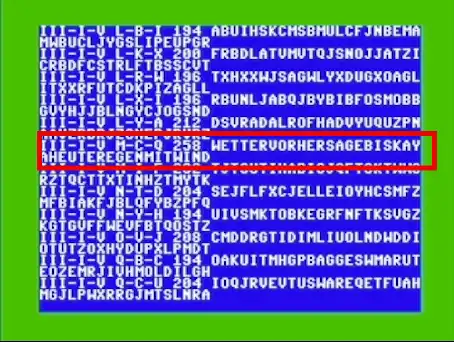
The correct answer, III-I-V at M-C-Q, among the gibberish. IC sum 258, ranked #42 overall.
With only 60 characters, random letter distributions can outscore real language. The correct answer stands out because it’s the only one that reads like German, not because it has the highest score. You find it by reading the printer output, not by sorting a spreadsheet.
Longer messages stabilize the IC. With 200+ characters, the correct decryption reliably scores highest. With 60, you need a threshold that keeps a manageable number of candidates for human review.
Pseudocode
for each rotor ordering (336 permutations):
  for each starting position (17,576 per ordering):
    decrypt the entire ciphertext with this setting
    count letter frequencies (26 bins)
    compute IC sum = sum of n_i * (n_i - 1)
    if IC sum >= threshold:
      CANDIDATE FOUND, print settings and decryption
The per-candidate cost is higher than the brute-force cracker. That approach tested the first character of the crib and bailed immediately on mismatch, averaging about one encryption per candidate. IC requires encrypting the entire message: 60 encryptions for our 60-character ciphertext, plus the frequency counting and sum computation.
But there’s no crib to find. No interrogating captured submariners, no stealing codebooks. Just raw ciphertext and math.
Across all 5.9 million candidates (336 orderings), a threshold of 0.050 produces about 94,887 hits (1.6%). The correct answer is among them, but so are thousands of gibberish decryptions that happen to have uneven letter distributions. A human scanning the output would spot the readable German, but an automated system would need additional filtering (bigram frequencies, dictionary checks, or a higher threshold that risks missing the answer).
BASIC Version
The BASIC version searches all 17,576 positions for a single rotor ordering. The rotor wiring, stepping, and encryption subroutines are identical to the cracker. The new code is the IC computation.
5 PRINT CHR$(5)
10 PRINT CHR$(147);"  ENIGMA IC ATTACK"
20 PRINT "  INDEX OF COINCIDENCE":PRINT
100 DIM RF(7,25),RI(7,25),RE(25)
110 FOR R=0 TO 7:FOR I=0 TO 25
120 READ RF(R,I):NEXT I,R
200 DATA 4,10,12,5,11,6,3,16,21,25
210 DATA 13,19,14,22,24,7,23,20,18,15
220 DATA 0,8,1,17,2,9
230 DATA 0,9,3,10,18,8,17,20,23,1
240 DATA 11,7,22,19,12,2,16,6,25,13
250 DATA 15,24,5,21,14,4
260 DATA 1,3,5,7,9,11,2,15,17,19
270 DATA 23,21,25,13,24,4,8,22,6,0
280 DATA 10,12,20,18,16,14
290 DATA 4,18,14,21,15,25,9,0,24,16
300 DATA 20,8,17,7,23,11,13,5,19,6
310 DATA 10,3,2,12,22,1
320 DATA 21,25,1,17,6,8,19,24,20,15
330 DATA 18,3,13,7,11,23,0,22,12,9
340 DATA 16,14,5,4,2,10
350 DATA 9,15,6,21,14,20,12,5,24,16
360 DATA 1,4,13,7,25,17,3,10,0,18
370 DATA 23,11,8,2,19,22
380 DATA 13,25,9,7,6,17,2,23,12,24
390 DATA 18,22,1,14,20,5,0,8,21,11
395 DATA 15,4,10,16,3,19
400 DATA 5,10,16,7,19,11,23,14,2,1
410 DATA 9,18,15,3,25,17,0,12,4,22
420 DATA 13,8,20,24,6,21
450 REM COMPUTE INVERSE TABLES
460 FOR R=0 TO 7:FOR I=0 TO 25
470 RI(R,RF(R,I))=I
480 NEXT I,R
500 REM REFLECTOR UKW-B
510 FOR I=0 TO 25:READ RE(I):NEXT
520 DATA 24,17,20,7,16,18,11,3,15,23
530 DATA 13,6,14,10,12,8,4,1,5,25
540 DATA 2,22,21,9,0,19
600 REM NOTCH POSITIONS (TWO PER ROTOR)
610 DIM NO(7,1)
620 NO(0,0)=16:NO(0,1)=-1
630 NO(1,0)=4:NO(1,1)=-1
640 NO(2,0)=21:NO(2,1)=-1
650 NO(3,0)=9:NO(3,1)=-1
660 NO(4,0)=25:NO(4,1)=-1
670 NO(5,0)=25:NO(5,1)=12
680 NO(6,0)=25:NO(6,1)=12
690 NO(7,0)=25:NO(7,1)=12
700 REM CIPHERTEXT (60 CHARS, 0-25)
710 DIM CT(59)
720 CT$="YDMAOIGMPQZPFVRCIGIIKJV"
725 CT$=CT$+"ECBDNPDITBYRYNKOCNJHII"
727 CT$=CT$+"VWXYUJBCDYGKVHW"
730 FOR I=0 TO 59
740 CT(I)=ASC(MID$(CT$,I+1,1))-65
750 NEXT
760 NL=60:TH=177
770 DIM FR(25)
800 PRINT "SELECT 3 ROTORS (1-8)"
810 INPUT "LEFT ROTOR";RL
820 INPUT "MIDDLE ROTOR";RM
830 INPUT "RIGHT ROTOR";RR
840 RL=RL-1:RM=RM-1:RR=RR-1
850 PRINT:PRINT "SEARCHING 17,576 POSITIONS"
860 PRINT "FOR ROTORS";RL+1;"-";RM+1;"-";RR+1
865 PRINT "THRESHOLD:";TH
870 PRINT:TI$="000000":SC=0
900 FOR L0=0 TO 25
910 PRINT CHR$(L0+65);" ";
920 FOR M0=0 TO 25:FOR R0=0 TO 25
930 GOSUB 5000
940 IF F=1 THEN GOSUB 7000
950 NEXT R0,M0,L0
960 PRINT:PRINT
970 PRINT SC;"CANDIDATES FOUND"
975 PRINT "TIME:";INT(TI/60);"SECONDS"
980 END
2000 REM STEP ROTORS
2010 IF MP<>NO(RM,0)ANDMP<>NO(RM,1) THEN 2040
2020 LP=LP+1:LP=LP-INT(LP/26)*26
2030 MP=MP+1:MP=MP-INT(MP/26)*26
2040 IF RP<>NO(RR,0)ANDRP<>NO(RR,1) THEN 2060
2050 MP=MP+1:MP=MP-INT(MP/26)*26
2060 RP=RP+1:RP=RP-INT(RP/26)*26
2070 RETURN
3000 REM ENCRYPT (FORWARD)
3010 E=(C+RP):E=E-INT(E/26)*26
3020 C=RF(RR,E)
3030 C=(C-RP+26):C=C-INT(C/26)*26
3040 E=(C+MP):E=E-INT(E/26)*26
3050 C=RF(RM,E)
3060 C=(C-MP+26):C=C-INT(C/26)*26
3070 E=(C+LP):E=E-INT(E/26)*26
3080 C=RF(RL,E)
3090 C=(C-LP+26):C=C-INT(C/26)*26
3100 REM REFLECTOR
3110 C=RE(C)
3120 REM ENCRYPT (INVERSE)
3130 E=(C+LP):E=E-INT(E/26)*26
3140 C=RI(RL,E)
3150 C=(C-LP+26):C=C-INT(C/26)*26
3160 E=(C+MP):E=E-INT(E/26)*26
3170 C=RI(RM,E)
3180 C=(C-MP+26):C=C-INT(C/26)*26
3190 E=(C+RP):E=E-INT(E/26)*26
3200 C=RI(RR,E)
3210 C=(C-RP+26):C=C-INT(C/26)*26
3220 RETURN
5000 REM IC TEST
5010 LP=L0:MP=M0:RP=R0
5020 REM CLEAR FREQUENCY TABLE
5030 FOR I=0 TO 25:FR(I)=0:NEXT
5040 REM DECRYPT AND COUNT
5050 FOR I=0 TO NL-1
5060 C=CT(I):GOSUB 2000:GOSUB 3000
5070 FR(C)=FR(C)+1
5080 NEXT
5090 REM COMPUTE IC SUM
5100 S=0
5110 FOR I=0 TO 25
5120 S=S+FR(I)*(FR(I)-1)
5130 NEXT
5140 IF S>=TH THEN F=1:RETURN
5150 F=0:RETURN
7000 REM SHOW CANDIDATE
7010 SC=SC+1
7020 PRINT:PRINT "CANDIDATE";SC
7030 PRINT "POSITION: ";CHR$(L0+65);"-";
7035 PRINT CHR$(M0+65);"-";CHR$(R0+65)
7040 PRINT "IC SUM:";S
7050 LP=L0:MP=M0:RP=R0
7060 FOR I=0 TO NL-1
7070 C=CT(I):GOSUB 2000:GOSUB 3000
7080 PRINT CHR$(C+65);
7090 NEXT
7100 PRINT:RETURN
The IC test at line 5000 is where the action is. It decrypts all 60 characters, counts the frequency of each letter in the FR array, then computes the IC sum: $\sum n_i \times (n_i - 1)$. If the sum meets the threshold (177, corresponding to IC >= 0.050), it’s a candidate.
Line 7000 prints each candidate with its position, IC sum, and decrypted text so you can scan for readable German.
The threshold of 177 comes from $0.050 \times 60 \times 59 = 177$. Lower it and you get more candidates (and more false positives). Raise it and you might miss the correct answer if the IC is noisy. For a 60-character message, 177 is a reasonable middle ground.
To check that it’s working, enter rotors 3, 1, 5 (the correct ordering from the previous articles). The program searches all 17,576 positions and prints each candidate that passes the threshold. Most of the output is gibberish with IC sums in the 180-200 range. But candidate 146 jumps out:
CANDIDATE 146
POSITION: M-C-Q
IC SUM: 258
WETTERVORHERSAGEBISKAYAHEUTEREGENMITWINDSTAERKEFUENFAUSOSTEN
That’s readable German. IC sum 258, well above the threshold of 177. Out of 286 total candidates for this rotor ordering, this is the only one that’s actual language. The rest are random letter salad that happened to have uneven frequency distributions.
Try entering a wrong ordering like 1, 2, 3. You’ll still get candidates (any ordering produces a few statistical flukes), but none of them will be readable. That’s the difference: wrong settings produce noise that occasionally looks uneven, while the right settings produce text that looks like German because it is German.
Assembly Version
The assembly version does the full search: all 336 rotor orderings, all 17,576 positions each. The structure is identical to the cracker, with the crib test replaced by the IC computation.
Here’s what the C64 has to chew through:
| Count | |
|---|---|
| Rotor orderings (P(8,3)) | 336 |
| Positions per ordering (26³) | 17,576 |
| Total candidates | 5,905,536 |
| Encryptions per candidate | 60 |
| Total encryptions | 354,332,160 |
| Rotor passes per encryption | 6 |
| Total rotor passes | 2,125,992,960 |
| Frequency table updates | 354,332,160 |
| IC sum computations (26 bins each) | 5,905,536 |
Over two billion rotor passes on a 1 MHz processor. The C64’s theoretical peak is about 0.5 MIPS (all 2-cycle instructions, which never happens in practice). Real-world throughput with mixed instructions is closer to 0.3 MIPS. Over 82 hours, the 6510 executes roughly 87 billion instructions and burns through 303 billion clock cycles. For more on what the 6510 can and can’t do at 1 MHz, see How Fast Can a 6502 Transfer Memory?.
The brute-force cracker averaged about one encryption per candidate thanks to early exit. The IC attack does 60 every time, no shortcuts.
The IC Test
The IC test decrypts the entire message, counts letter frequencies in a 26-byte table, and computes the IC sum as a 16-bit value:
; ic test
; decrypts ciphertext, computes ic sum
; returns z flag set if sum >= threshold
testic
          ; clear frequency table
          ldx #25
          lda #0
ticlr    sta freq,x
          dex
          bpl ticlr

          ; set starting positions
          lda trylp
          sta leftpos
          lda trymp
          sta midpos
          lda tryrp
          sta rightpos

          ; decrypt and count
          ldx #0
tidec    lda cipher,x
          stx savex
          jsr encrypt
          ; increment freq[a]
          tax
          inc freq,x
          ldx savex
          inx
          cpx #60
          bne tidec

          ; compute ic sum (16-bit)
          ; sum = sigma(freq[i]*(freq[i]-1))
          lda #0
          sta iclo
          sta ichi
          ldx #0
tisum    lda freq,x
          beq tiskip
          ; a = n = freq[i]
          ; compute n*(n-1)
          ; freq values max ~10 for 60 chars
          ; so product fits in one byte
          tay
          dey
          sty temp
          iny
          lda #0
          clc
timul    adc temp
          dey
          bne timul
          ; add to 16-bit sum
          clc
          adc iclo
          sta iclo
          bcc tiskip
          inc ichi
tiskip   inx
          cpx #26
          bne tisum

          ; compare sum to threshold (194)
          ; 16-bit compare: ichi:iclo >= 0:194
          lda ichi
          bne tipass
          lda iclo
          cmp #194
          bcs tipass
          lda #1
          rts
tipass   lda #0
          rts
The frequency counting is simple: decrypt each character with jsr encrypt, use the result as an index into freq, and increment. After all 60 characters, loop through the 26 frequency bins computing $n \times (n-1)$ for each. The maximum possible IC sum (if all 60 characters were the same letter) would be $60 \times 59 = 3540$, which fits in 16 bits. We accumulate the total in iclo/ichi.
The multiplication uses repeated addition. With frequency values rarely above 10 for a 60-character message, this loop runs at most 10 iterations per bin. For bins with count 0 or 1, the product is zero and we skip the multiply entirely.
The threshold compare is a 16-bit check. If the high byte is nonzero, the sum is at least 256, which is above 194, so it passes immediately. Otherwise compare the low byte to 194.
The assembly version uses a tighter threshold (194, IC >= 0.055) than the BASIC version (177, IC >= 0.050). The BASIC version searches one rotor ordering at a time, so 286 candidates is manageable. The assembly version searches all 336 orderings, and at 177 that would produce roughly 95,000 candidates. At 194, it drops to about 16,500. The correct answer scores 258, so it passes either threshold easily.
The Search Loop
The position loop calls testic instead of the loop test and crib verification. There’s no two-phase filtering here, just one test:
sprp
          ; test ic
          jsr testic
          beq tifound

          ; failed
          inc tryrp
          lda tryrp
          cmp #26
          bne sprp
          inc trymp
          lda trymp
          cmp #26
          bne spmp
          inc trylp
          lda trylp
          cmp #26
          bne splp
          rts

tifound
          ; print candidate
          jsr showcand
          ; keep searching (don't stop)
          jmp tinext
One difference from the cracker: we don’t stop at the first match. The IC test produces multiple candidates, so we print each one and keep searching. The operator reads the output and picks the one that looks like German.
In practice, you’d want a printer connected. The search runs for hours and produces thousands of candidates. They scroll off a 25-line screen long before the search finishes. With a printer, you get a paper log to read through when it’s done. open 4,4:cmd 4 before running redirects output to a Commodore printer. print#4:close 4 when finished.
Showing Candidates
When a candidate passes the IC test, we print the rotor ordering, position, IC sum, and the first 40 characters of the decrypted text. The operator scans for readable German among the gibberish:
showcand
          lda #13
          jsr chrout
          ; print position
          lda trylp
          clc
          adc #65
          jsr chrout
          lda #45
          jsr chrout
          lda trymp
          clc
          adc #65
          jsr chrout
          lda #45
          jsr chrout
          lda tryrp
          clc
          adc #65
          jsr chrout
          lda #32
          jsr chrout
          ; print ic sum
          lda ichi
          ldx iclo
          jsr $bdcd
          lda #32
          jsr chrout
          ; decrypt and print first 40 chars
          lda trylp
          sta leftpos
          lda trymp
          sta midpos
          lda tryrp
          sta rightpos
          ldx #0
scloop   lda cipher,x
          stx savex
          jsr encrypt
          clc
          adc #65
          jsr chrout
          ldx savex
          inx
          cpx #40
          bne scloop
          rts
The Full Listing
Here’s the complete IC attack. It assembles at $c000 and runs with sys 49152. The rotor wiring, stepping, encryption, and search structure are identical to the cracker. The only new code is testic and showcand. The border color changes with each new rotor ordering, so if it’s still cycling, it’s still searching.
Same advice about the printer applies here. The assembly version searches all 336 orderings and produces thousands of candidates over several hours. Hook up a printer before running, or you’ll only see whatever’s still on screen when it finishes:
OPEN 4,4:CMD 4:SYS 49152:PRINT#4:CLOSE 4
; ==============================
; enigma ic attack
; index of coincidence search
; commodore 64
; rotors i-viii (m3), no plugboard
; turbo macro pro / tmpx
; by michael doornbos 2026
; mike@imapenguin.com
;
; decrypts ciphertext with each
; candidate setting, computes ic
; of the result, flags candidates
; with ic above threshold
;
; no crib needed
;
; .null/.text = screen codes
; use .byte for petscii strings
; ==============================
* = $c000
; --- zero page ---
ptr = $50
rightpos = $fb
midpos = $fc
leftpos = $fd
temp = $fe
chrout = $ffd2
; === entry point ===
; zero jiffy clock and accumulator
lda #0
sta $a2
sta $a1
sta $a0
sta jtotal
sta jtotal+1
sta jtotal+2
sta jtotal+3
; cls, white text
lda #$93
jsr chrout
lda #5
jsr chrout
lda #13
jsr chrout
; header
ldx #<stitle
ldy #>stitle
jsr print
lda #13
jsr chrout
ldx #<ssub
ldy #>ssub
jsr print
lda #13
jsr chrout
lda #13
jsr chrout
; searching message
ldx #<ssearch
ldy #>ssearch
jsr print
lda #13
jsr chrout
; init candidate count
lda #0
sta candlo
sta candhi
; run search
jsr searchall
; restore border
lda #14
sta $d020
; show total
lda #13
jsr chrout
lda #13
jsr chrout
ldx #<stotal
ldy #>stotal
jsr print
lda candhi
ldx candlo
jsr $bdcd
ldx #<scands
ldy #>scands
jsr print
lda #13
jsr chrout
; show elapsed time
ldx #<stime
ldy #>stime
jsr print
jsr jiffysec
lda #13
jsr chrout
rts
; === search all orderings ===
; p(8,3) = 336 permutations
searchall
lda #0
sta tryl
saleft lda #0
sta trym
samid lda trym
cmp tryl
beq sasm
lda #0
sta tryr
saright lda tryr
cmp tryl
beq sasr
cmp trym
beq sasr
; valid permutation
jsr searchpos
sasr inc tryr
lda tryr
cmp #8
bne saright
sasm inc trym
lda trym
cmp #8
bne samid
inc tryl
lda tryl
cmp #8
bne saleft
sadone rts
; === search positions ===
; 26^3 = 17,576 per ordering
searchpos
; accumulate jiffy clock, then zero it
; prevents kernal midnight reset (24h)
sei
clc
lda jtotal
adc $a2
sta jtotal
lda jtotal+1
adc $a1
sta jtotal+1
lda jtotal+2
adc $a0
sta jtotal+2
bcc jnoc
inc jtotal+3
jnoc lda #0
sta $a2
sta $a1
sta $a0
cli
; configure rotors
lda tryl
sta leftsel
lda trym
sta midsel
lda tryr
sta rightsel
; border color = progress
inc $d020
; sweep all positions
lda #0
sta trylp
splp lda #0
sta trymp
spmp lda #0
sta tryrp
sprp
; test ic
jsr testic
beq tifound
; failed
jmp tinext
tifound
; show candidate
jsr showcand
tinext inc tryrp
lda tryrp
cmp #26
bne sprp
inc trymp
lda trymp
cmp #26
bne spmp
inc trylp
lda trylp
cmp #26
bne splp
rts
; === test ic ===
; decrypts ciphertext
; computes ic sum
; returns z flag set if >= threshold
testic
; clear frequency table
ldx #25
lda #0
ticlr sta freq,x
dex
bpl ticlr
; set starting positions
lda trylp
sta leftpos
lda trymp
sta midpos
lda tryrp
sta rightpos
; decrypt all 60 chars
ldx #0
tidec lda cipher,x
stx savex
jsr encrypt
; count frequency
tax
inc freq,x
ldx savex
inx
cpx #60
bne tidec
; compute ic sum (16-bit)
lda #0
sta iclo
sta ichi
ldx #0
tisum lda freq,x
beq tiskp
cmp #1
beq tiskp
; a = n, compute n*(n-1)
tay
dey
sty temp
iny
lda #0
clc
timul adc temp
dey
bne timul
; add to 16-bit sum
clc
adc iclo
sta iclo
bcc tiskp
inc ichi
tiskp inx
cpx #26
bne tisum
; compare to threshold 194
lda ichi
bne tiyes
lda iclo
cmp #194
bcs tiyes
; below threshold
lda #1
rts
tiyes lda #0
rts
; === show candidate ===
showcand
; increment count
inc candlo
bne scnoc
inc candhi
scnoc
lda #13
jsr chrout
; print ordering
ldx leftsel
jsr printrn
lda #45
jsr chrout
ldx midsel
jsr printrn
lda #45
jsr chrout
ldx rightsel
jsr printrn
lda #32
jsr chrout
; print position
lda trylp
clc
adc #65
jsr chrout
lda #45
jsr chrout
lda trymp
clc
adc #65
jsr chrout
lda #45
jsr chrout
lda tryrp
clc
adc #65
jsr chrout
lda #32
jsr chrout
; print ic sum
lda ichi
ldx iclo
jsr $bdcd
lda #32
jsr chrout
; decrypt first 40 chars
lda trylp
sta leftpos
lda trymp
sta midpos
lda tryrp
sta rightpos
ldx #0
scloop lda cipher,x
stx savex
jsr encrypt
clc
adc #65
jsr chrout
ldx savex
inx
cpx #40
bne scloop
rts
; === encrypt ===
; a = letter (0-25) in/out
; no plugboard (identity)
encrypt pha
jsr step
pla
; right fwd
ldx rightsel
jsr setfwd
ldx rightpos
jsr rotorpass
; middle fwd
ldx midsel
jsr setfwd
ldx midpos
jsr rotorpass
; left fwd
ldx leftsel
jsr setfwd
ldx leftpos
jsr rotorpass
; reflector
tax
lda reflector,x
; left inv
ldx leftsel
jsr setinv
ldx leftpos
jsr rotorpass
; middle inv
ldx midsel
jsr setinv
ldx midpos
jsr rotorpass
; right inv
ldx rightsel
jsr setinv
ldx rightpos
jsr rotorpass
rts
; === step rotors ===
; dual notch for vi-viii
step
ldx midsel
lda midpos
cmp notch1,x
beq dodouble
cmp notch2,x
bne nodouble
dodouble
; double step
lda leftpos
clc
adc #1
jsr mod26
sta leftpos
lda midpos
clc
adc #1
jsr mod26
sta midpos
jmp stepright
nodouble
ldx rightsel
lda rightpos
cmp notch1,x
beq domid
cmp notch2,x
bne stepright
domid lda midpos
clc
adc #1
jsr mod26
sta midpos
stepright
lda rightpos
clc
adc #1
jsr mod26
sta rightpos
rts
; === mod26 ===
mod26 cmp #26
bcc m26done
sbc #26
m26done rts
; === rotor pass ===
rotorpass
stx temp
clc
adc temp
jsr mod26
tay
lda (ptr),y
sec
sbc temp
clc
adc #26
jsr mod26
rts
; === set table pointer ===
setfwd ldy fwdlo,x
sty ptr
ldy fwdhi,x
sty ptr+1
rts
setinv ldy invlo,x
sty ptr
ldy invhi,x
sty ptr+1
rts
; === print string ===
; x=lo, y=hi, null-terminated
print stx ptr
sty ptr+1
ldy #0
ploop lda (ptr),y
beq pdone
jsr chrout
iny
bne ploop
pdone rts
; === print rotor name ===
; x = rotor index (0-7)
printrn
lda rnlo,x
sta ptr
lda rnhi,x
sta ptr+1
ldy #0
rnloop lda (ptr),y
beq rndone
jsr chrout
iny
bne rnloop
rndone rts
; === jiffy clock to hours/minutes ===
; adds remaining jiffies to 32-bit total
; divides by 60 three times: jiffies->sec->min->hr
jiffysec
; add remaining jiffies to accumulator
sei
clc
lda jtotal
adc $a2
sta dividend+3
lda jtotal+1
adc $a1
sta dividend+2
lda jtotal+2
adc $a0
sta dividend+1
lda jtotal+3
adc #0
sta dividend
cli
; 32-bit divide by 60
lda #0
sta remainder
ldx #32
jsloop asl dividend+3
rol dividend+2
rol dividend+1
rol dividend
rol remainder
lda remainder
cmp #60
bcc jsskip
sbc #60
sta remainder
inc dividend+3
jsskip dex
bne jsloop
; dividend = total seconds
; divide by 60 to get minutes
lda dividend
sta jsecs
lda dividend+1
sta jsecs+1
lda dividend+2
sta jsecs+2
lda dividend+3
sta jsecs+3
lda #0
sta remainder
ldx #32
jsloop2 asl jsecs+3
rol jsecs+2
rol jsecs+1
rol jsecs
rol remainder
lda remainder
cmp #60
bcc jsskp2
sbc #60
sta remainder
inc jsecs+3
jsskp2 dex
bne jsloop2
; divide minutes by 60 to get hours
lda #0
sta remainder
ldx #32
jsloop3 asl jsecs+3
rol jsecs+2
rol jsecs+1
rol jsecs
rol remainder
lda remainder
cmp #60
bcc jsskp3
sbc #60
sta remainder
inc jsecs+3
jsskp3 dex
bne jsloop3
; print hours
lda jsecs+2
ldx jsecs+3
jsr $bdcd
lda #72 ; 'h'
jsr chrout
lda #32
jsr chrout
; print remaining minutes
lda #0
ldx remainder
jsr $bdcd
lda #77 ; 'm'
jsr chrout
rts
dividend .byte 0,0,0,0
jsecs .byte 0,0,0,0
remainder .byte 0
; === data ===
; search state
savex .byte 0
jtotal .byte 0,0,0,0
tryl .byte 0
trym .byte 0
tryr .byte 0
trylp .byte 0
trymp .byte 0
tryrp .byte 0
; rotor config
rightsel .byte 0
midsel .byte 0
leftsel .byte 0
; ic state
iclo .byte 0
ichi .byte 0
candlo .byte 0
candhi .byte 0
; frequency table (26 bytes)
freq .repeat 26,0
; ciphertext (60 chars, 0-25)
cipher .byte 24,3,12,0,14,8
.byte 6,12,15,16,25,15
.byte 5,21,17,2,8,6
.byte 8,8,10,9,21,4
.byte 2,1,3,13,15,3
.byte 8,19,1,24,17,24
.byte 13,10,14,2,13,9
.byte 7,8,8,21,22,23
.byte 24,20,9,1,2,3
.byte 24,6,10,21,7,22
; notch positions (i-viii)
notch1 .byte 16,4,21,9,25
.byte 25,25,25
; second notch ($ff = none)
notch2 .byte $ff,$ff,$ff,$ff,$ff
.byte 12,12,12
; address tables (rotors i-viii)
fwdlo .byte <rot1f,<rot2f
.byte <rot3f,<rot4f
.byte <rot5f,<rot6f
.byte <rot7f,<rot8f
fwdhi .byte >rot1f,>rot2f
.byte >rot3f,>rot4f
.byte >rot5f,>rot6f
.byte >rot7f,>rot8f
invlo .byte <rot1i,<rot2i
.byte <rot3i,<rot4i
.byte <rot5i,<rot6i
.byte <rot7i,<rot8i
invhi .byte >rot1i,>rot2i
.byte >rot3i,>rot4i
.byte >rot5i,>rot6i
.byte >rot7i,>rot8i
; === rotor wiring ===
; i: ekmflgdqvzntowyhxuspaibrcj
rot1f .byte 4,10,12,5,11,6
.byte 3,16,21,25,13,19
.byte 14,22,24,7,23,20
.byte 18,15,0,8,1,17
.byte 2,9
; ii: ajdksiruxblhwtmcqgznpyfvoe
rot2f .byte 0,9,3,10,18,8
.byte 17,20,23,1,11,7
.byte 22,19,12,2,16,6
.byte 25,13,15,24,5,21
.byte 14,4
; iii: bdfhjlcprtxvznyeiwgakmusqo
rot3f .byte 1,3,5,7,9,11
.byte 2,15,17,19,23,21
.byte 25,13,24,4,8,22
.byte 6,0,10,12,20,18
.byte 16,14
; iv: esovpzjayquirhxlnftgkdcmwb
rot4f .byte 4,18,14,21,15,25
.byte 9,0,24,16,20,8
.byte 17,7,23,11,13,5
.byte 19,6,10,3,2,12
.byte 22,1
; v: vzbrgityupsdnhlxawmjqofeck
rot5f .byte 21,25,1,17,6,8
.byte 19,24,20,15,18,3
.byte 13,7,11,23,0,22
.byte 12,9,16,14,5,4
.byte 2,10
; vi: jpgvoumfyqbenhzrdkasxlictw
rot6f .byte 9,15,6,21,14,20
.byte 12,5,24,16,1,4
.byte 13,7,25,17,3,10
.byte 0,18,23,11,8,2
.byte 19,22
; vii: nzjhgrcxmyswboufaivlpekqdt
rot7f .byte 13,25,9,7,6,17
.byte 2,23,12,24,18,22
.byte 1,14,20,5,0,8
.byte 21,11,15,4,10,16
.byte 3,19
; viii: fkqhtlxocbjspdzramewniuygv
rot8f .byte 5,10,16,7,19,11
.byte 23,14,2,1,9,18
.byte 15,3,25,17,0,12
.byte 4,22,13,8,20,24
.byte 6,21
; inverse tables
rot1i .byte 20,22,24,6,0,3
.byte 5,15,21,25,1,4
.byte 2,10,12,19,7,23
.byte 18,11,17,8,13,16
.byte 14,9
rot2i .byte 0,9,15,2,25,22
.byte 17,11,5,1,3,10
.byte 14,19,24,20,16,6
.byte 4,13,7,23,12,8
.byte 21,18
rot3i .byte 19,0,6,1,15,2
.byte 18,3,16,4,20,5
.byte 21,13,25,7,24,8
.byte 23,9,22,11,17,10
.byte 14,12
rot4i .byte 7,25,22,21,0,17
.byte 19,13,11,6,20,15
.byte 23,16,2,4,9,12
.byte 1,18,10,3,24,14
.byte 8,5
rot5i .byte 16,2,24,11,23,22
.byte 4,13,5,19,25,14
.byte 18,12,21,9,20,3
.byte 10,6,8,0,17,15
.byte 7,1
rot6i .byte 18,10,23,16,11,7
.byte 2,13,22,0,17,21
.byte 6,12,4,1,9,15
.byte 19,24,5,3,25,20
.byte 8,14
rot7i .byte 16,12,6,24,21,15
.byte 4,3,17,2,22,19
.byte 8,0,13,20,23,5
.byte 10,25,14,18,11,7
.byte 9,1
rot8i .byte 16,9,8,13,18,0
.byte 24,3,21,10,1,5
.byte 17,20,7,12,2,15
.byte 11,4,22,25,19,6
.byte 23,14
; ukw-b reflector
reflector .byte 24,17,20,7,16,18
.byte 11,3,15,23,13,6
.byte 14,10,12,8,4,1
.byte 5,25,2,22,21,9
.byte 0,19
; === strings (petscii) ===
; " enigma ic attack"
stitle .byte 32,32,69,78,73,71
.byte 77,65,32,73,67,32
.byte 65,84,84,65,67,75
.byte 0
; " no crib needed"
ssub .byte 32,32,78,79,32,67
.byte 82,73,66,32,78,69
.byte 69,68,69,68,0
; " searching..."
ssearch .byte 32,32,83,69,65,82
.byte 67,72,73,78,71,46
.byte 46,46,0
; " total: "
stotal .byte 32,32,84,79,84,65
.byte 76,58,32,0
; " candidates"
scands .byte 32,67,65,78,68,73
.byte 68,65,84,69,83,0
; " time: "
stime .byte 32,32,84,73,77,69
.byte 58,32,0
; " seconds"
ssec .byte 32,83,69,67,79,78
.byte 68,83,0
; rotor names (petscii)
rn1 .byte 73,0
rn2 .byte 73,73,0
rn3 .byte 73,73,73,0
rn4 .byte 73,86,0
rn5 .byte 86,0
rn6 .byte 86,73,0
rn7 .byte 86,73,73,0
rn8 .byte 86,73,73,73,0
rnlo .byte <rn1,<rn2,<rn3
.byte <rn4,<rn5,<rn6
.byte <rn7,<rn8
rnhi .byte >rn1,>rn2,>rn3
.byte >rn4,>rn5,>rn6
.byte >rn7,>rn8
Timing
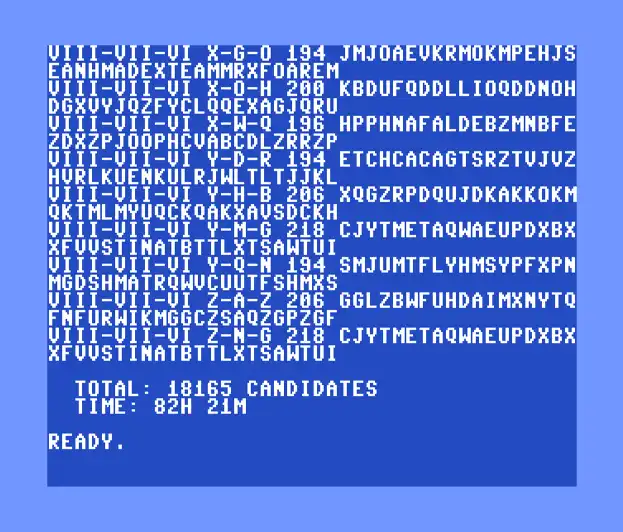
18,165 candidates in 82 hours. The 6510 earned its keep.
The IC attack is slower per candidate than the brute-force cracker. Each candidate requires decrypting all 60 characters (60 encrypt calls) plus the frequency counting and IC sum computation. The cracker averaged about 1.04 encryptions per candidate thanks to early exit on the first crib character.
On a stock NTSC C64, the full IC search through all 5.9 million candidates takes 82 hours (about 3.4 days), producing 18,165 candidates at the 194 threshold.
The Jiffy Clock Problem
The C64’s jiffy clock at $a0-$a2 is 24 bits, which can count up to 16,777,216 jiffies (about 77.7 hours at 60 Hz). But the KERNAL never lets it get that high. The UDTIM routine at $f69b, called 60 times per second by the IRQ handler, resets the clock to zero when it reaches 5,184,000 jiffies (24 hours). It’s a time-of-day clock, not a free-running counter. From the original Commodore source:
; here we check for roll-over 23:59:59
; and reset the clock to zero if true
ud30    sec
        lda time+2
        sbc #$01
        lda time+1
        sbc #$1a
        lda time
        sbc #$4f
        bcc ud60
; time has rolled--zero register
        stx time
        stx time+1
        stx time+2
An 82-hour search hits this reset three times. If you just read the clock at the end, you get the time since the last midnight reset, not the total elapsed time. I learned this the hard way after a four-day run reported ten hours. The fix: at each rotor ordering (every ~15 minutes), read the jiffy clock, add it to a 32-bit accumulator, and zero the clock. The KERNAL reset never fires because the clock never reaches 24 hours.
You don’t have to wait for the full search, though. The correct answer (III-I-V at M-C-Q) is ordering #87 out of 336. It shows up on the printer about 21 hours in, less than a day. The remaining 61 hours just confirm there’s nothing better hiding in the other orderings.
Where the Cycles Go
The rotorpass routine is where the CPU spends most of its time. It runs 2.1 billion times across the full search. Here’s every instruction with its cycle count:
rotorpass
          stx temp       ; 3  save position offset
          clc            ; 2
          adc temp       ; 3  add position to letter
          jsr mod26      ; 17 reduce mod 26
          tay            ; 2  use as table index
          lda (ptr),y    ; 5  look up rotor wiring
          sec            ; 2
          sbc temp       ; 3  subtract position
          clc            ; 2
          adc #26        ; 2  keep positive
          jsr mod26      ; 17 reduce mod 26
          rts            ; 6
                         ; total: 64 cycles
Each jsr mod26 costs 6 cycles for the call, then a compare, a conditional subtract, and a return. About 17 cycles total depending on whether the value needs reducing.
Each encrypt call does 6 of these (3 forward through the rotors, 3 inverse), plus table pointer setup (setfwd/setinv at 26 cycles each), stepping, and the reflector lookup. One full encrypt comes to about 720 cycles.
The inner loop does that 60 times per candidate (once per ciphertext character), then counts frequencies and computes the IC sum. Across 5.9 million candidates on an NTSC C64 at 1,022,727 Hz, the whole search takes 82 hours.
The tradeoff: the IC attack trades speed for generality. It’s slower than a crib-based attack, but it doesn’t need known plaintext. When you have a crib, use it. When you don’t, IC is your best option.
IC vs. Crib Attack
| Crib Attack | IC Attack | |
|---|---|---|
| Needs known plaintext? | Yes | No |
| Per-candidate cost | ~1 encryption (early exit) | 60 encryptions + frequency counting |
| Plugboard | Ignored (solved separately) | Ignored (IC is plugboard-invariant) |
| False positives | None (exact match) | 18,165 candidates at threshold 194 |
| Output | Single correct answer | Multiple candidates for human review |
| Time (assembly, all 336 orderings) | ~22 minutes | ~82 hours (~3.4 days) |
The IC attack was never used operationally against Enigma during the war. Bletchley Park had enough cribs from weather reports, re-sends, and formulaic messages that the Bombe was the practical choice. IC analysis was well understood (Friedman published it in 1922), but the computational cost of decrypting entire messages for every candidate setting made it impractical with 1940s technology.
On a C64, the cost is steep but possible. With a crib, the brute-force cracker solved the same message in about 22 minutes. Without one, the IC attack takes three and a half days. That’s the price of not knowing anything about the plaintext. But the answer lands on the printer in about 21 hours. Just plug in a printer, type sys 49152, and go live your life for a while.
The Same Search on Modern Hardware
The IC attack is embarrassingly parallel. Every candidate is independent. No shared state, no ordering dependencies. A modern machine can throw cores and GPU threads at it without coordination.
I ported the same algorithm to C and ran it three ways on an Apple M4:
| Version | Time | Candidates/sec | Speedup vs C64 |
|---|---|---|---|
| C64 (6502 assembly, 1 MHz) | 82 hours | ~20 | 1x |
| C, single-threaded (-O3) | 1.856s | 3.2 million | 159,000x |
| C, OpenMP (all CPU cores) | 0.409s | 14.4 million | 722,000x |
| Metal GPU (M4) | 0.039s | 151 million | 7,569,000x |
All four produce the same 18,165 candidates. Same algorithm, same rotor tables, same threshold. The GPU version finishes before your finger leaves the Enter key.
OpenMP splits the 336 orderings across all CPU cores. Nearly linear scaling. The GPU goes further, running all 5.9 million candidates as parallel threads. Each GPU core handles one candidate start to finish. The rotor tables and ciphertext fit in shared memory, so there’s no memory bottleneck.
To put the C64’s 82 hours in perspective, here’s what the same search would take on machines available in 1983, alongside some modern hardware. These estimates scale linearly by MIPS, which is rough but directionally right for this kind of integer-heavy table-lookup workload.
| Machine | Year | MIPS | Estimated time |
|---|---|---|---|
| Commodore 64 | 1982 | 0.3 | 82 hours (measured) |
| IBM PC XT (8088, 4.77 MHz) | 1983 | 0.33 | 74 hours |
| VAX-11/780 | 1977 | 1.0 | 25 hours |
| IBM 3081K mainframe | 1982 | 16 | 93 minutes |
| Cray-1 (scalar) | 1976 | 80 | 18 minutes |
| Cray X-MP (scalar, 1 CPU) | 1982 | 105 | 14 minutes |
| AMD Ryzen 9 9950X (1 core) | 2024 | ~28,000 | ~3.2 seconds |
| Apple M4 (1 core) | 2024 | ~24,000 | 1.856 seconds (measured) |
| Apple M4 (all cores, OpenMP) | 2024 | - | 0.409 seconds (measured) |
| Apple M4 GPU (Metal) | 2024 | - | 0.039 seconds (measured) |
The IBM PC XT is the fun one. The 8088 runs at nearly 5x the C64’s clock speed but delivers about the same integer throughput. Its 8-bit external bus and microcode overhead eat up the clock advantage. The VAX-11/780, the machine that literally defined “1 MIPS,” would have finished in about a day. The Cray-1 could have done it during a coffee break, but using a 10-million-dollar vector supercomputer for integer table lookups would have been a hard budget request to justify. Then again, if you’re trying to win a war, that budget gets approved.
The M4’s actual measured time (1.856 seconds single-threaded) is faster than the MIPS estimate because MIPS doesn’t capture what modern hardware really does. The C compiler eliminates subroutine call overhead, the branch predictor nails the inner loop, and every rotor table lookup hits L1 cache. The 6510 spends 64 cycles per rotor pass with two subroutine calls. The M4 burns through the same logic in a few nanoseconds.
The same math that took 82 hours on a C64 runs in 39 milliseconds on a GPU you can buy at the Apple Store.
Extra Credit
A few ways to take this further:
-
Pre-filter with IC: Use IC as a first pass to narrow down rotor orderings. For each ordering, compute IC for a sample of positions. If no position scores well, skip the ordering entirely. This reduces the search space for any follow-up attack.
-
Bigram scoring: IC uses single-letter frequencies. Bigram frequencies (pairs like TH, ER, EN in German) are an even stronger signal. Count all 676 bigram frequencies and compare to expected German bigrams. Higher accuracy, but the frequency table grows from 26 bytes to 676 bytes.
-
Solve the plugboard: Once IC identifies the correct rotor settings, the plugboard can be deduced using frequency analysis. Compare the letter frequencies of the rotor-only decryption to expected German frequencies. The mapping from observed frequencies to expected frequencies reveals the plugboard swaps.
-
Variable threshold: Use a sliding threshold based on message length. Shorter messages need a lower threshold (more false positives) because the IC is noisier. Longer messages allow a higher threshold (fewer false positives). Pre-compute the threshold for the specific message length.
All the code from this article (6502 assembly, C, OpenMP, Metal GPU, and Python verification) is on GitHub: mrdoornbos/enigma_ic.
Going Faster on the C64
The emulator article pointed out that mod26 could be inlined to save cycles. In the IC attack, rotorpass calls jsr mod26 twice per pass. Each jsr/rts pair costs 12 cycles. Over 2.1 billion rotor passes, that’s about 50 billion wasted cycles just bouncing in and out of a 3-instruction subroutine.
The fix is simple. Replace the two jsr mod26 calls with the comparison inline:
rotorpass
          stx temp
          clc
          adc temp
          cmp #26
          bcc rp1
          sbc #26
rp1       tay
          lda (ptr),y
          sec
          sbc temp
          clc
          adc #26
          cmp #26
          bcc rp2
          sbc #26
rp2       rts
Same logic, no subroutine calls. The mod26 routine still exists for the stepping code (which runs once per character, not worth optimizing), but the rotor pass is where the CPU lives for 82 hours.
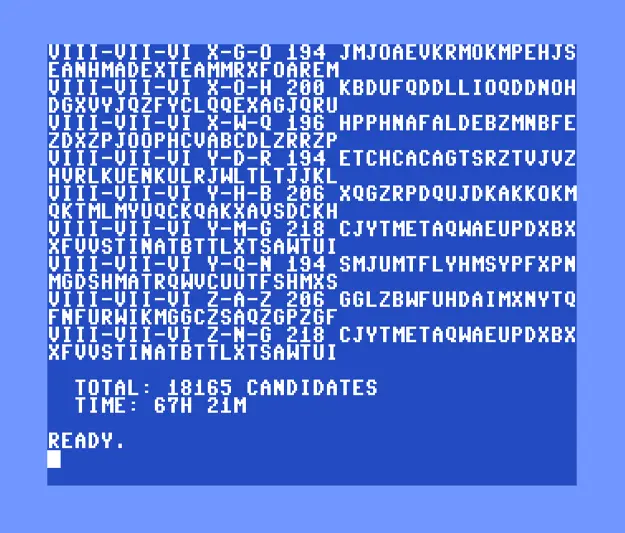
67 hours 21 minutes. Same 18,165 candidates, 15 hours faster.
The result: 67 hours, down from 82. An 18% speedup from removing two jsr instructions. The code is 6 bytes larger. On a machine that runs for days, inlining a hot subroutine is the easiest optimization you can make.